
Discover Guerlain Samsara: its origins, olfactory architecture, reformulation history, and why vintage bottles remain the ultimate collector's prize. The definitive guide to an iconic perfume.
Originally published in 2016; fully updated in 2026
Images posted for purely informative and historical purposes. All rights belong to their legitimate owners. Please note: Raiders of the Lost Scent is an independent editorial platform. We are not involved in the commercial trade of perfumes and do not sell fragrances.
I. The origins of Guerlain Samsara: a love story at the twilight of a Dynasty.
The story of Guerlain Samsara begins not in a laboratory, but in a love affair.
In 1985, Jean-Paul Guerlain, the last perfumer of the founding family, heir to a lineage stretching back to Pierre-François Pascal Guerlain in 1828, began composing a wholly private work.
His muse was Décia de Pauw, an accomplished horsewoman who lamented that no existing perfume suited her. She loved two materials above all others: jasmine and sandalwood.
From that intimate brief, one of the most celebrated fragrances of the twentieth century was born. For four years, she alone wore it.
When Guerlain prepared to launch Samsara perfume to the world in 1989, the circumstances were exceptional in every respect. For the first time in the house's 161-year history, external perfumers were invited to submit competing compositions alongside Jean-Paul's own formula.
His creation prevailed. As he would later assert, "only a Guerlain could truly create a Guerlain" a claim rooted not in arrogance, but in a proprietary tradition of in-house accords and raw material sourcing cultivated over generations.
Anne-Marie Saget collaborated on the structural refinement that gave the formula its architectural elegance.
The launch date carried its own symbolic weight: 1989 fell exactly one century after Jicky, the house's founding masterpiece. That centennial symmetry was no accident: it was a deliberate reaffirmation of Guerlain's singular position in the canon of French haute parfumerie.
To underscore the ambition, the advertising campaign commanded a reported investment approaching $50 million, one of the largest in perfume history at the time.
And it was a big risk, because Guerlain came from three perfumes with modest sales: Nahema (1979), Jardins de Bagatelle (1983), Derby (1985).
In 1994, five years after the launch of Samsara, the house passed into the ownership of LVMH, closing forever the long chapter of family-directed perfumery.
In retrospect, Guerlain Samsara stands as one of the final autonomous statements of the dynasty: a grand gesture made in the last years before the curtain fell.
II. The name, the bottle, and the philosophy behind Samsara.
Every element of Samsara by Guerlain was conceived as a coherent philosophical statement, not merely a commercial product.
The name itself is drawn from Sanskrit, where samsara denotes the wheel of existence: the continuous cycle of birth, death, and rebirth from which liberation, or nirvana, is ultimately sought.
It is one of the most precisely chosen names in the history of perfumery: a word that carries within it both the beauty of cyclical return and the ache of impermanence.
That Jean-Paul Guerlain chose it for a fragrance born of personal longing and devotion is not accidental.
The bottle, designed by Robert Granai, remains one of the most instantly recognisable icons in modern perfume design. Its voluptuous silhouette draws inspiration from a Cambodian dancer statue housed in the Musée Guimet in Paris.
The deep red glass evokes a sacred Buddhist hue. Granai later recalled how inspiration finally came at the Musée Guimet after failed attempts elsewhere.
The original Samsara launched in 1989 as Eau de Parfum, marking the first time Guerlain used this designation across its range.
The Eau de Toilette followed in 1991. In 1990, it won the Fragrance Foundation's Women's Luxury Fragrance of the Year award.
III. The Olfactory architecture: how Samsara perfume redefined sandalwood.
At its core, Samsara is the perfume that permanently altered the role of sandalwood in fine fragrance.
The opening is luminous: bergamot, lemon, green notes, peach, and ylang-ylang.
The heart combines jasmine, rose, narcissus, violet, iris, and orris root.
The base is where Samsara perfume achieves its singular greatness. Mysore sandalwood (Santalum album) was used at unprecedented concentration (around 30%).
Vanilla, tonka bean, amber, and musk extend longevity and sillage.
IV. Reformulation, Vintage collecting, and the enduring legacy of Guerlain Samsara.
For collectors, reformulation is central to understanding Samsara.
Due to restrictions on Mysore sandalwood, modern versions rely more on synthetic replacements such as Polysantol.
Early vintage versions remain richer, denser, and more materially complex.
Collectors prize late 1980s and early 1990s bottles, especially parfum and early eau de parfum formats.
Samsara remains one of the defining perfumes of late 20th-century perfumery.
It marked the end of Guerlain family independence and the rise of a new era under LVMH.
For collectors, a vintage bottle is not simply a fragrance but a historical artifact.

Year 1991
Launch of Eau de Toilette:
30/50/100ml splash and spray bottles in transparent glass without golden ring,
93ml cylindrical refillable EdT spray bottle ("Copyright 1982" golden canister),
plus EdP and EdT refillable red plastic bottle, 100ml.

Year 1995
Un Air de Samsara, Eau de Toilette (flanker, discontinued)

Year 1999 – New Packaging
Complete repackaging: new EdT and EdP in red-glass bottles with fixed rotating caps.
- Parfum bottles similar to previous ones
- Crystal transparent bottles discontinued
- Splash bottles discontinued
- New golden canisters ("Copyright 1996")
- New box and red cover
- Miniatures: red bottles, 5ml

Year 1991
Launch of Eau de Toilette:
30/50/100ml splash and spray bottles (transparent glass, WITHOUT golden ring)
93ml cylindrical refillable EdT spray bottle ("Copyright 1982" golden canister)
Plus: EdP and EdT refillable red plastic bottle, 100ml
Year 1995
Un Air de Samsara – EdT (flanker, discontinued)
Year 1999 – New Packaging
Complete repackaging: new EdT and EdP in red-glass bottles with fixed rotating caps.
Parfum bottles similar to previous ones.
Crystal bottles discontinued.
Splash bottles discontinued.
New golden canisters ("Copyright 1996") for refillables.
New box and red cover.
Miniatures: red bottles 5ml.

Year 2000
Limited editions EdT and EdP with golden “maps” on bottles.

Year 2001
Launch of Samsara Shine EdT (flanker, discontinued)

Year 2004 – New Boxes
New red boxes (without covers) with double G logo.

Year 2007
New red boxes with current Guerlain logo.

Year 2016 – Bee Bottle

Year 2021 – Les Légendaires

Chapter 2 – Reformulations
First Serie (1989-1999)
Transparent, clear bottles - the concentration (Parfume, EdT or EdP) is written ABOVE the word "Samsara" on the box

 |
| Eau de Parfum, transparent glass bottle with a golden ring |
 |
| Eau de Toilette (since 1991) in a transparent glass bottle, WITHOUT the golden ring |
 |
| ....and check for the copyright: "year 1988" |
Examples from
First Serie (1989-1999)
 |
| Parfum, 30ml ----------------------------------------- |


with squared golden canister "Copyright 1982"
------------------------------------------------


30 ml spray with RED cap (right)
-----------------------------------


 |
| Parfum, 2ml, miniature in cardboard box |


 |
| EdP 2ml. miniature |
----------------------------------------------
Second Serie (1999-2004)
written BELOW the word "Samsara" on the box.
Red bottles - the concentration (EDT or EdP) is
----------------------------------
 |
| During 1999-2004 : red covers (left) put over the box (right) |
 |
| ...and check for the "copyright" : year 1999. |
Examples from 2nd serie (1999-2004):
 |
| Parfum with its cover |


---------------------------


 |
| 50ml EdP Refillable |
Third Serie (2004-2007)
box with the "double G" golden logo on the
upper front (and no "covers")


Fourth Serie (since 2007)
Plain boxes with modern Guerlain logo


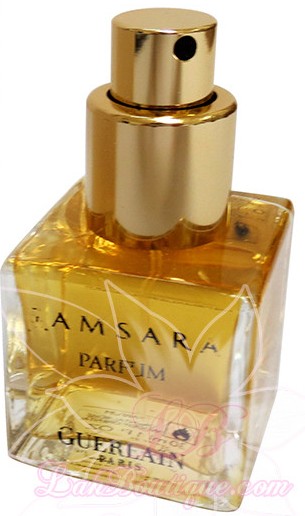


--------------------------------
Chapter 4
Year-by-Year
for a complete Batch-numbers guide see:
How to recognize Guerlain Perfumes


 |
| Parfum, 7.5ml refillable without its plastic case (batch "DE") |
 |
| Eau de Parfum, 75ml / 2.5oz Splash |
(6-digits batch code, starting with M)
 |
| Eau de Parfum, 100ml refillable spray, batch "MC" |


 |
| Eau de Parfum, 75 ml splash, batch "MR" |
 |
| EdP 50ml spray, 6-digits batch "MH" = year 1990 |
 |
| Edp, 30ml spray, batch ML |
1991


 |
| Parfum, 30 ml, batch "UH" |
 |
| Eau de Toilette, 100ml spray, batch "UB" |
 |
| EdP, 7.5ml miniature |
 |
| EdP, 50ml spray, batch "UR" |
1992
(6-digits batch, starting with Z)
 |
| Eau de Parfum, 50ml spray, batch "ZC" |
 |
| Eau de Parfum, 50ml spray, batch "ZE" |
-----------------------


 |
| Eau de Toilette, 50ml spray, batch "JX" |
 |
| EdP, 7.5ml miniature, batch "JK" |
-------------------
 |
| Parfum, 7.5ml, batch "YF" |
 |
| "Le Meteorites", 7.5ml Parfum Spray Refillable, batch "YF" |
 |
| 93ml EdT Refillable, batch YH |
1995


1996


 |
| Eau de Toilette, 50 ml spray, batch "PB" |
 |
| 93 ml refillable EdT, batch "PB" |
 |
| Eau de Toilette, 7.5ml miniature, batch "PL" |
1997
 |
| Eau de Toilette, 50ml spray, batch "SC" |
------------------------------------------------


red bottles, fixed caps, box with "cover"
EdP: golden cap - EdT: red cap
(5-digits batch codes starting with D)
 |
| NEW EdP: red bottle, golden cap, box and "cover" |
|
| NEW EdT : red bottle, red cap, box and cover |
 |
| Notice "Copyight Guerlain 1999" on the box |

 |
| Eau de Toilette, 93ml, refillable, batch DL |
 |
| Eau de Parfum, 30ml spray, batch "DN" |
 |
| EdP, 50 ml spray, batch DK2ME (on the cover) |
2000
 |
| Eau de Toilette, 50 ml spray, batch "MC" |
 |
| Eau de Toilette, 93 ml refillable, batch MK |
 |
| Parfum, 15ml, batch "ME" |
(5-digits batch, starting with U)
 |
| Eau de Toilette, 100 ml |
 |
| Samsara Shine, EdT, 30ml |
 |
| EdT recharge, 93ml |
-------------------------------
since 2002
(4-digits batch codes, first number is the year)

 |
| Eau de toilette, 50ml, batch 2H03 = year 2002 |
 |
| EdP, 50ml, batch 6F01 = year 2006 |
Recent bottles, since 2007
 | ||
| 30 ml, year 2008 |

 |
| 100ml, EdP, Year 2010 |
 |
| 100ml, EdT, year 2010 |
 |
| 100 ml, EdP, year 2013 |
 |
| 30ml, EdP, year 2013 |
---------------------------------
Chapter 5
---------------------------------

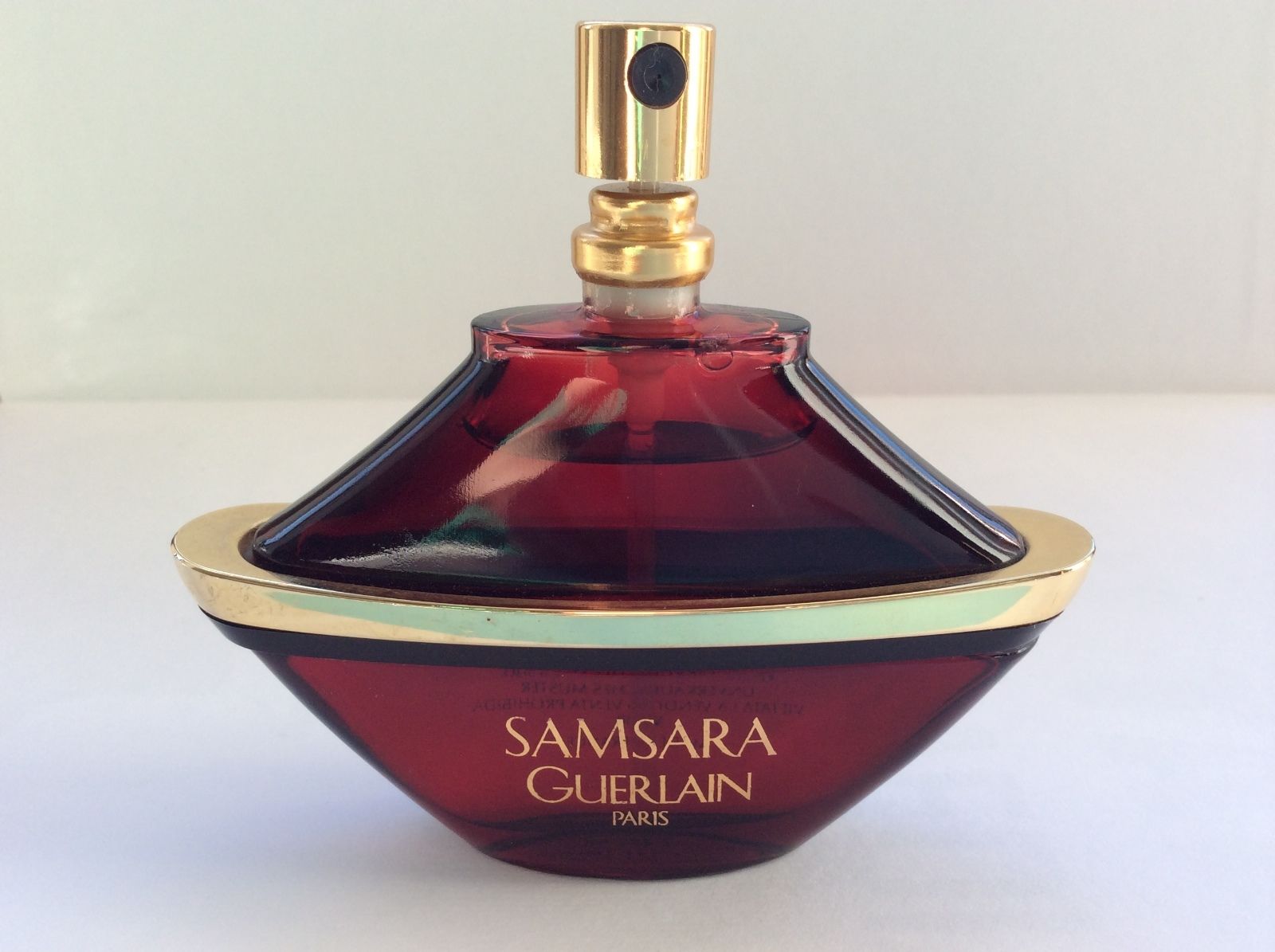
  |
| 15ml x4 EdT Purse Spray, in plastic case, year 2002 |
 |
| Samsara "Les Meteorites", Parfum Spray Refillable |
 |
| "Les Meteorites", Eau de Parfum Spray Refillable |
 |
| "Les Meteorites", Eau de Parfum Spray Refillable |
 |
| 100g. Talc |
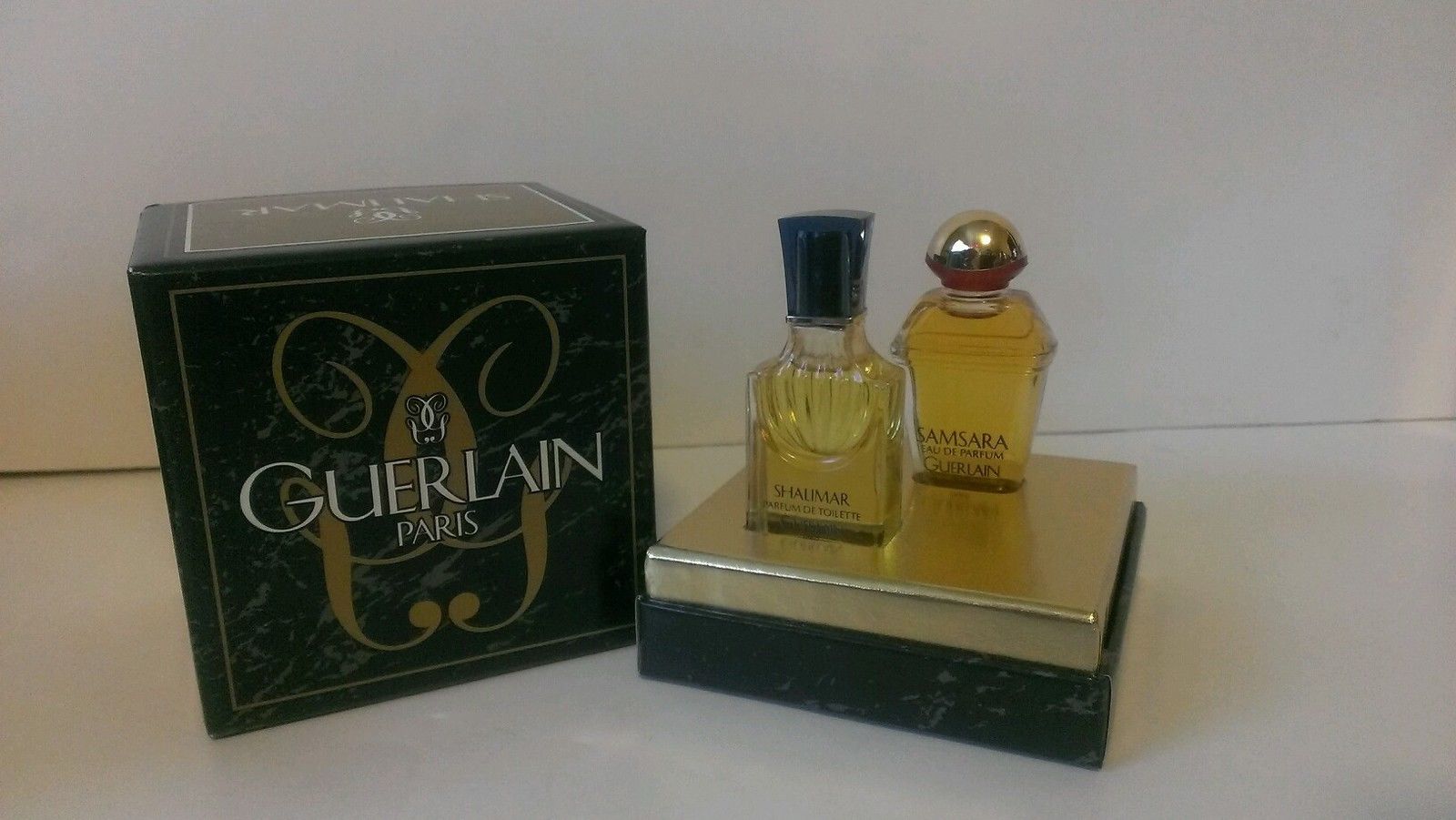 |
| "Duet of Luxury" limited edition (Samsara EdP plus Shalimar PdT, both 7.5ml) |


 |
| Body Creme |
 |
| Perfumed Deodorant |
 |
| Factices |
 |
| Soaps (3x box) |
------------------------------------------------------------------- |
| Soap (single) |
 |
| 1ml. EdT sample vial in plastic case |
 |
| 1 ml EdP sample vial in plastic case |
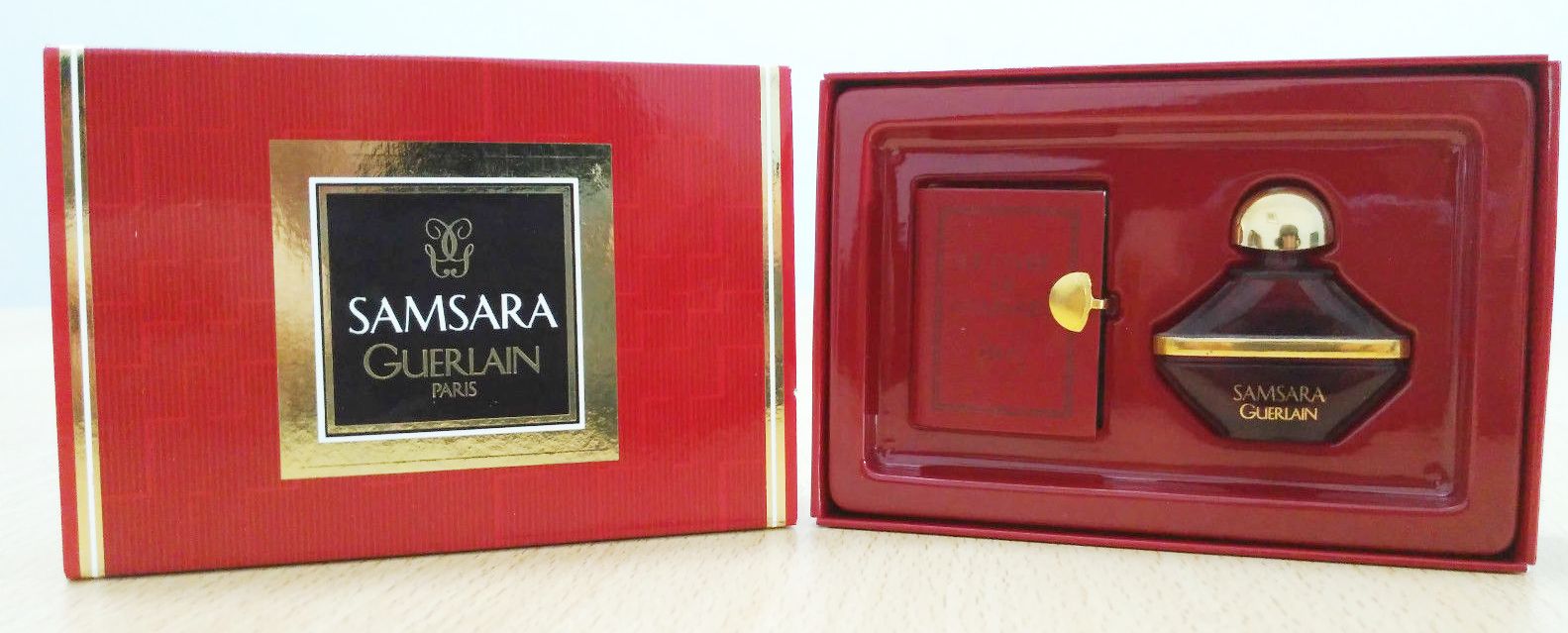 |
| 2 ml Parfum + minibook, year 1991 |
 |
| Eau de Parfum, limited edition, year 2000 (in this picture with its cover) |
|
| Eau de toilette, limited edition, year 2000 (in this picture with box but without its cover) |
 |
| 5ml mini, year 2000 |
 |
| Samsara Shine Purse Spray, year 2001 |
 |
| Pin |
  |
| Samsara Limited Edition set: 30ml EdT, 15ml EdP, 7.5ml Parfum, 2ml Parfum |
 |
| Samsara package |


---------------------------------------------------------
 |
| Samsara Sensual Spirit, roll-on eau de toilette, year 2001 |
----------------------------------------------- |
| Samsara Refreshing Perfume Dew, year 2001 |
---------------------------------------
Gift Sets/Coffrets
----------------------------------------
 |
| Mother's day, 1990 |


"The Samsara Book" + 2ml Parfum, Christmas 1991
-------------------------------


---------------------------------------------------------
 |
| Coffret from Nineties |
--------------------------------------------------------


 |
| Coffret from Nineties |


 |
| Coffret year 1994 |


 |
| Coffret from 2000s |
 |
| Coffret from 2000s |
 |
| Coffret from 2000s |


 |
| Christmas 2006 |
 |
| Christmas 2009 |
---------------------------------
Advertising
---------------------------------


----------------------------------------
"Colophon"

-------------------------------------------------------------------------------------
Share this article:WHATSAPP TELEGRAM PINTEREST FACEBOOK REDDIT
About the Authors: We are a collective of fragrance specialists and historians based in Italy, France and Switzerland, dedicated to the study and preservation of olfactory heritage. Founded in 2009, our project is rooted in a family lineage in the art of perfumery dating back to 1919. Bringing over a century of combined expertise to every review, we provide insights into the world of vintage scents. Every article is a result of research and experience with original specimens. Images posted for purely informative and historical purposes. All rights belong to their legitimate owners. Please note: Raiders of the Lost Scent is an independent editorial platform. We are not involved in the commercial trade of perfumes and do not sell fragrances.Share this article: WHATSAPP TELEGRAM PINTEREST FACEBOOK REDDIT
Hey there, I love Samsara too. What a fantastic resource this will be for buying vintage. Thanks for all the hard work.
ReplyDeletePortia xx
Hey, Thanks for the article. Really loved it. Extremely detailed and very precise. Keep Writing. Thanks :)
ReplyDeleteWell done and great write up about a bold and beautiful perfume. How do we obtain the Samsara perfume fragrance of old (other than ebay)? Have you ever found a person/business making old fragrances. I do miss the original Samsara.
ReplyDeleteThanks - this is FABULOUS. I am new to Samsara, but I'm snatching up every older version I can find. This information is PRICELESS!
ReplyDeletePerfect. Big work. Thank you very much.
ReplyDelete