The ultimate guide to Azzaro pour Homme: vintage and modern versions explained, with details on historical periods, boxes, bottles, labels, and all you need to know about the legendary Azzaro pour Homme.
Azzaro pour Homme is an institution: it's one of the most famous perfumes ever created. In the middle of the 1980s, "Azzaro pour Homme" and "Drakkar Noir" by Guy Laroche accounted together for almost 40% of all male perfume sales. During those years, if you wanted to buy a perfume "for men", you had to choose between "Azzaro" and "Drakkar Noir".
There are several different noses apparently claiming to have contributed to its creation (namely: Gérard Anthony, Martin Heiddenreich, Richard Wirtz, and probably others), plus several urban legends surrounding the creation of "Azzaro pour Homme".
Probably we will not know the true story behind this perfume, but the legends are quite fascinating. The whole project was almost discarded for several reasons: Loris Azzaro, a well-known couturier "pour femmes", was dubious about being involved in a perfume "pour homme".
Apart from this, perfumers wanted the new scent to be better than "Paco Rabanne pour Homme" (the real benchmark for male perfumery in those years), but the formula was too complex (nearly 320 ingredients).
At last, Azzaro pour Homme arrived on shelves and it was an instant success. If you search all over the web, you will find a lot of articles narrating these fascinating stories.
Thanks to our loyal friends, we succeeded in finding testers and bottles from various ages to perform another nice "comparison test". Let's examine all bottles.
The First Bottle (1978-1997)
- Full-size "L" and "A" logo (Loris Azzaro) on the box.
- Silver sticker on the bottle.
- "Round" cap.
- 1978 to mid-80s: "Parfums Loris Azzaro SA Paris" in a single line.
- Mid-80s to 1997: "Loris Azzaro - Paris" in two lines on the bottle.
- Bar-code on the box after 1990; Green dot after 1992.
Typical mid-1980s box and bottle
 |
Early bottle: "Parfums Loris Azzaro SA Paris" in a single row
on the bottom of the bottle: between 1978 and mid-1980s
|
 |
| Typical mid 1980s bottle, with "Loris Azzaro- Paris" in two lines on the bottle |
 |
"First bottle" after year 1992, with barcode and GreenDot on the box.
Notice the "90%" and "fl.oz. ml" removed from the front of the bottle |
-------------------------------------------
The Second bottle (1997-2007)
Medium size "L"and"A" logo on the box
Silver sticker on the bottle.
Hexagonal cap.
Short list of ingredients ("Alcohol-Parfum-Water") until 2004
-------------------------------------
The Third bottle (since 2007)
Small-size "L" and "A" logo on the box
Glass logo on the bottle (instead of the silver sticker)
Hexagonal cap.
(In these bottles, check the six-digits batch code: the first number = the year.)
---------------------------------------
Comparating boxes and bottles
 |
| Boxes: Second (left) and First (right) |
 |
| First (left) and Second (right) bottles |
 |
| First, Second, and Third boxes (front side) |
 |
| First, Second, Third boxes (back sides) |
 |
| First, Second, Third (left-to-right) |
------------------------------------------
According to....Gianni Bertetti
(Gianni Bertetti from Turin, Italy, is a sort of living memory of vintage perfumery: his story is narrated HERE)
"Those were great years! Couturiers and stylists entered in the perfume field for the first time, and almost all fragrances were top-quality ones. Even today, although continue reformulations, these perfumes still retain a cult status and plenty of loyal followers. I perfectly remember Azzaro pour Homme, it was released in 1978, this fragrance was bold and elegant at the same time, and immediately got many admirers. Distributors made real fortunes with it. Azzaro pour Homme was very hard -almost impossible- to keep up with requests, it was immediately sold-out by arriving on the shelves....I still find it a very enjoyable fougère, certainly better than many other common fragrances available in our days."
--------------------------------------------------
Side-by-side Test
Azzaro pour Homme is one of the few perfumes to be allegedly reformulated by the House. It happened during 1997, due to IFRA restrictions, and likely another reformulation happened around 2010.
So, let's go and compare three different bottles, the first produced during mid-Eighties, the second around year 2000 (reformulated), and the third bought after 2010 (probably another reformulation underwent).
Obviously, all tests were performed side-by-side in the same moment, in the same room, in the same "overall conditions".


Can we spot any difference with a side-by-side test? The answer is : yes.
The good news is that reformulations didn't destroy the scent. It's always Azzaro pour Homme, without any doubt. But differences actually exist.
The older one is a bit different from others. The main difference is the the sense of "perfect blend". The vintage perfume appears without any edge, smooth, more aromatic, and almost delicate in its bitterness. You could say it a "smooth fougère" with the typical bitter notes softened, levigated, without asperities.
The newer versions, on the contrary, appear a bit more "sharp", less aromatic, less "blended". Single notes appear bold and heavy, without too much smoothness. The newest version (since 2010) is even more "rude" and heavy than previous ones. Bitter notes are really bitter ones. There is no attempt to "smooth" and "sweeten" the blend.
On the other side, all versions has same longevity and sillage. Newer versions are both strong and intense, both in longevity and sillage. There is no real winner in these aspects.
In conclusion, if you prefer a perfect "fougère"-type scent, you should seek for a vintage bottle (1978-1997). If you prefer an heavy, in-your-face version of Azzaro pour Homme, the modern version (2010-ongoing) is perfect.
The "middle" version (1997-2007) is probably a sort of compromise between vintage and new.
Personally, I prefer the smoother, perfect-blended vintage version.
--------------------------
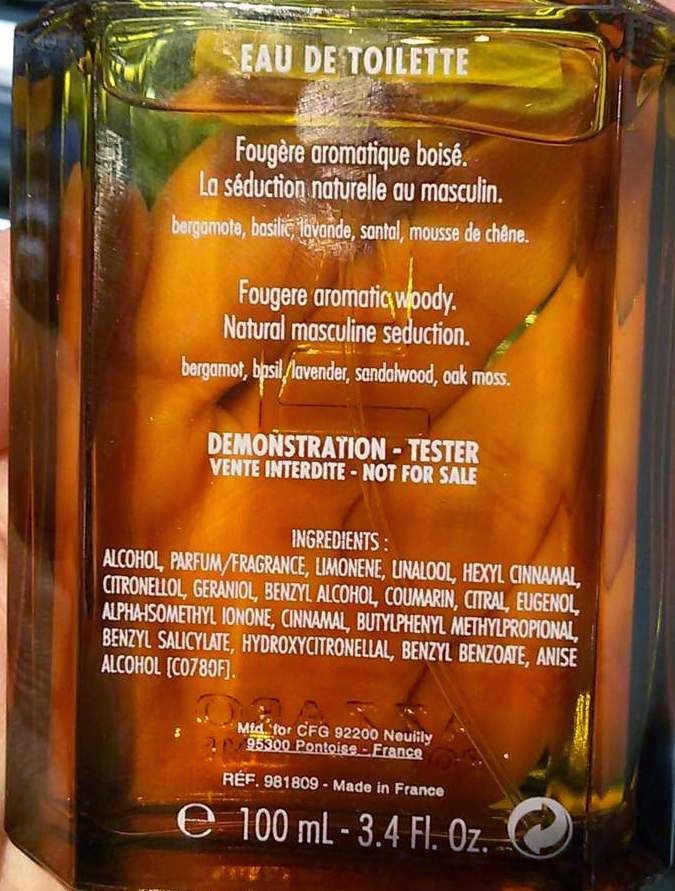
What a surprise!
The first, very rare, tester....
...and a modern (year 2014) tester: spot the differences...

------------------------------------------------------
THE FINAL WORD
by Luca Turin
"The monotheist among us believe there is only one proper gender of masculine fragrance: the Fougère. And that its apex was reached with the aromatic fougères in the late 1970s.
Some, and I among them, believe that the finest aromatic ever was Azzaro pour Homme (1978). You can tell it was a perfume aimed to smart guys. The slogan "Un parfum pour les hommes qui aimant le femmes qui aimant les hommes" is not for the slow-witted.
I wore it today for the first time in twenty years, ant it felt just as it always did: affable, slightly vulgar, completely unpretentious, and overall just delicious.
This fragrance is so good and historically so important, that I have met to date six perfumers to claim to have composed it (Gerard Anthony was officially credited) which put it in the same league as Giorgio and a few others for multiple attribution.
Azzaro's other fragrances have mostly been disappointments, but all is forgiven. Just keep making this one."
------------------------------------
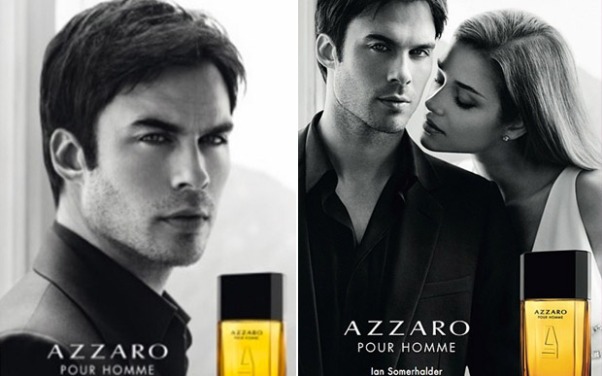
ADVERTISING
Year-by-Year
 |
| YEAR 1978 |
 |
| YEARS 1978 to 1989 |
 |
| YEARS 1992 to 1997 |
 |
AZZARO INTENSE (year 1993).
(bottle without sticker in year 1993? yes, but this is the AZZARO INTENSE version) |
 |
| YEAR 1998 |
 |
| YEAR 1998 |
 |
| YEARS 1999 to 2001 |
 |
| YEAR 1998 |
 |
| YEAR 2000 |
 |
| Year 2005 |
 |
| YEAR 2007 |
 |
| Years 2009 to 2013 |
 |
| Years 2009 to 2013 |
 |
| Vintage 250 ml (8.2 fl.oz) |
 |
| 400 ml bottle (13.5 fl oz) |
-------------------------
FLANKERS and Limited Editions
 |
| Azzaro Intense (first version, year 1992) |
 |
| Azzaro Cuir Edition, 2008 |
 |
| Azzaro pour Homme Elixir (year 2009) |
 |
Azzaro pour Homme Bois Precieux
(year 2010, limited edition) |
 |
Azzaro Homme Elixir Bois Precieux
(year 2010, limited edition) |
 |
| Azzaro pour Homme L'Eau (year 2011) |
 |
| Azzaro pour Homme Night Time (year 2011) |
 |
| Limited edition, year 2013 |
 |
| Limited edition, year 2014 |
 |
| Limited edition, 2015 |
 |
| Azzaro pour Homme Intense (Second version, year 2015) |
---------------------------------------------
BIBLIOGRAPHY
 Interested in AZZARO pour Homme?
read here (reviews):
Scents of Smell
Mimi Frou Frou
Pour Monsieur
The Scentualist
From Pyrgos
Cologneisseur
O Perfumistico
Princess of Jozi
Interested in AZZARO pour Homme?
read here (reviews):
Scents of Smell
Mimi Frou Frou
Pour Monsieur
The Scentualist
From Pyrgos
Cologneisseur
O Perfumistico
Princess of Jozi
 ---------------------------------
A very, very big Thanks to Gianni Ambrosio, Gianni Bertetti, and Luca Turin.
---------------------------------
similar "comparison" articles:
If you found this article helpful,
if you feel the information provided by "Raiders of the Lost Scent" has helped you in any way over the years, then we kindly ask you to make a small donation—completely voluntary—to help us. "Raiders of the Lost Scent" is a completely free site, and always will be. Raiders needs the help of its friends to continue to exist!
"Buy us a coffee" or "Donate via PayPal"
....and...
Batch-codes
Year-of-production,
all-you-need-to-know
about vintage perfumes in the following pages:
Share this article:
WHATSAPP
TELEGRAM
PINTEREST
FACEBOOK
REDDIT






Perfect as always Andre!
ReplyDeleteMany many thanks...
excelente Andre! como siempre!
ReplyDeletemuchas gracias por compartir tus conocimientos!
Brilliant review of this incredible men`s fragrance. Thank you Andre!
ReplyDeleteI was a fan off this parfum early 80 ,i wish they make again big miss.
ReplyDeleteExcellent review, my all time favorite fragrance, Shame on Azzaro for the reformulation.
ReplyDeleteBuongiorno, questo articolo è fantastico. Mi sebra che possiammo aggiungere la prima versione con "90°" invece di 90% sulla scatola e la bottigilia. Ho una bottigila in 125ML nuova con 90° (scusa per il mio italiano). se volete qualque foto, mio email: alfagtv0@gmail.com (non so come mettere qui delle foto). Ancore grazie per la vostra passionne, Diego
ReplyDeleteBuongiorno e mille grazie per questo articolo. Volevo solo agguingere, se non mi sbaglio, che esiste una prima versione con 90° (invece di 90%). Ho una bottiglia di 125ML con questo 90°. Se volete qualcque foto per il vostro blog, ve le posso mandare. Distinti saluti dal Belgio, Diego
ReplyDeleteThank you for this post! Since 2020, it’s part of L’oreal and in my opinion they have ruined this fragrance. I have used it from 1985 upto 2020 and I still miss is. What are your thought?
ReplyDeleteHi, here at "Raiders" we thought "The Older, the Better". But there are a lot of people who think that "new is better", so it's just a personal opinion. However, we still prefer vintage versions.. Thank you, Laura.
DeleteLa nueva reformulación 06/2022 está muy bien lograda, brillan todas las notas y está ultra potente me duró más de 14h un lujo, está modernizada.
ReplyDelete