
Originally published in 2013; fully updated in 2026 with new insights and photos.
Images posted for purely informative and historical purposes. All rights belong to their legitimate owners. Disclaimer: Raiders of the Lost Scent does not sell perfumes, not online and not in stores, and is not engaged in any kind of commercial activity.
A complete guide to Guerlain perfumes, from vintage classics to modern creations, covering historical periods, boxes, bottles, labels, batch codes, and all the details you need to identify authentic Guerlain fragrances.
Introduction: Guerlain, from vintage classics to modern fragrances
Among the great perfume houses, none presents the enthusiast and collector with a more intricate documentary landscape than Guerlain.
This guide examines the full arc of Guerlain's material history, from the packaging of the 1950s to the transitional years of the early 21st century, with particular attention to boxes, labels, batch codes, and the typographical and regulatory markers that allow the informed observer to date and authenticate a Guerlain fragrance with reasonable precision.
The task is not a simple one. Over the course of its long history, Guerlain employed a succession of coding systems, combining letters and numerals to record the year and month of manufacture.
These systems were neither consistent across the entire range nor always applied uniformly, which means that packaging must be read as a whole: box design, labels, batch code, and launch date considered in concert rather than in isolation. I would suggest referring to the photos for guidance. In this case, a picture is worth a thousand words.
The importance of the boxes
Let's start! (See tutorial pictures below.)
- Blue "ribbon" boxes: 1950s
- Dot (or "Coffee Beans") boxes: 1960s until 1967
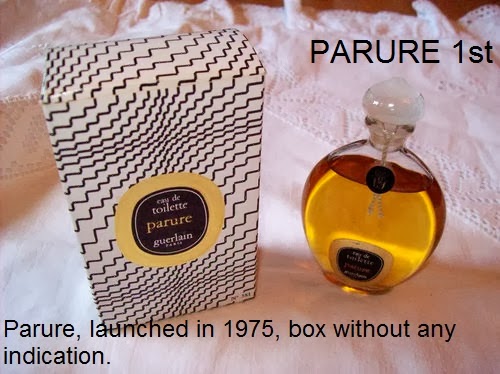
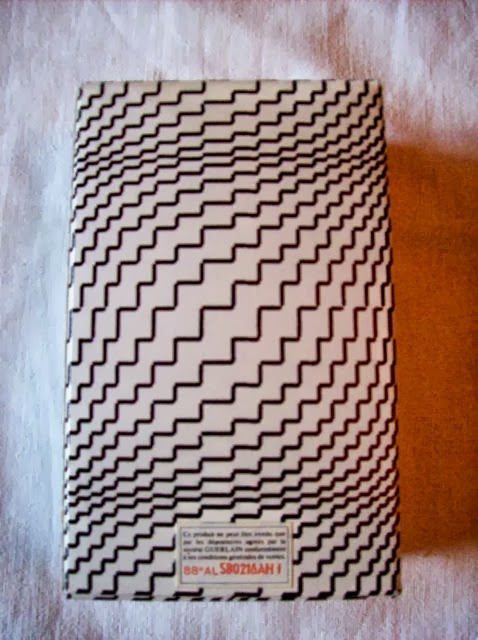
- Black & White "ZigZag" boxes: from 1967 until 1983
Since the end of the Seventies, the Estimated Sign appeared on all Guerlain boxes. When we see a Black & White "ZigZag" box with the Estimated Sign, it means approximately: end of Seventies / beginning of Eighties (until 1983).
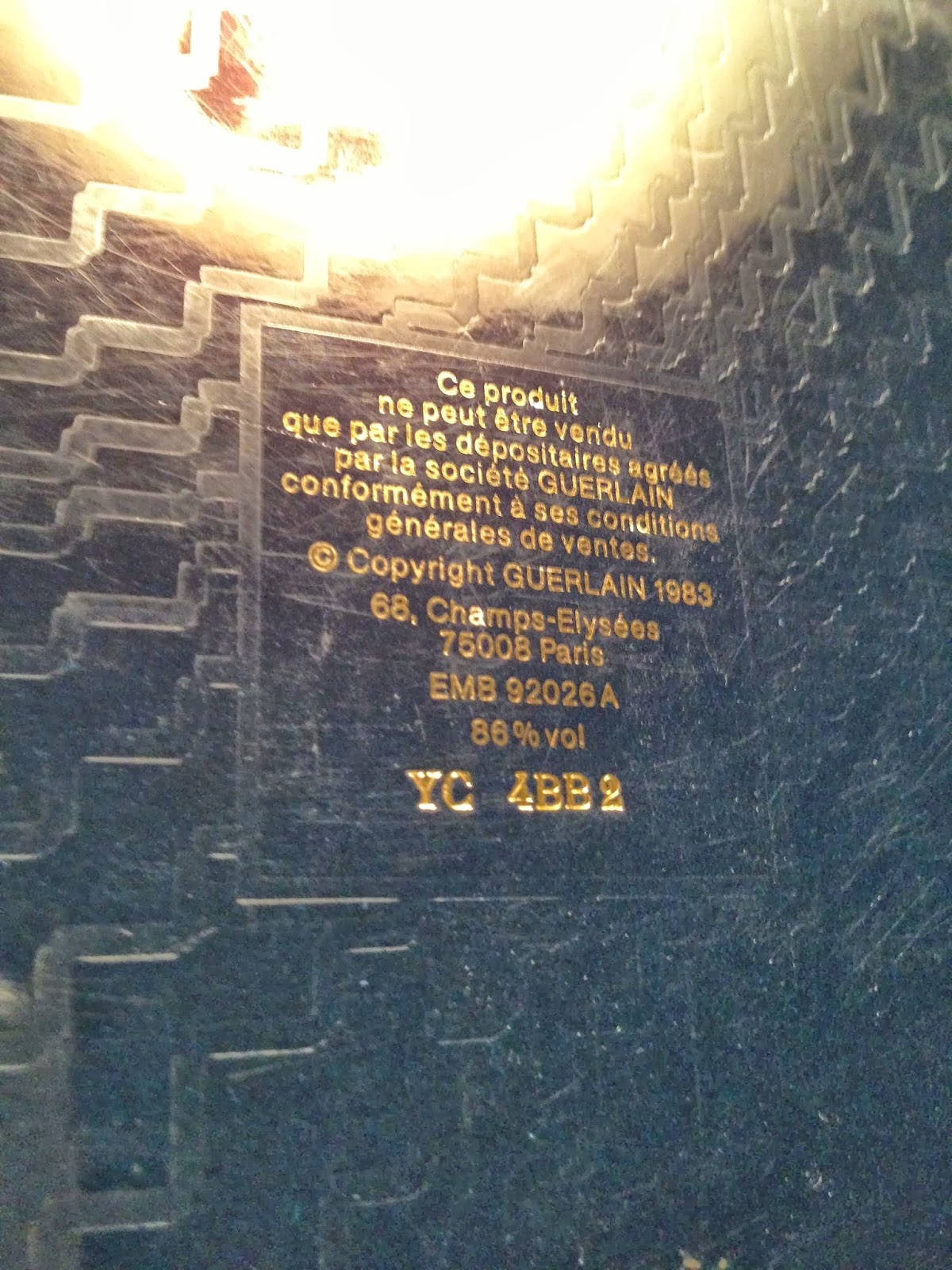
After 1983, "ZigZag" boxes are not "Black & White" anymore, but made in different colors, mostly "Black & Gold".
The "Black & Gold" ZigZag boxes were used (with partial discontinuation since 1996) until 2008 at the latest, then replaced with the "pastel" ones.
However, it is important to notice that:
- Not all Guerlain perfumes adopted the same box type.
- Several perfumes went through different boxes during 1983–2008 (a 25-year span), so the situation is genuinely complex.
Short on time? A single glance at the box will often suffice: the absence of a barcode places the piece before 1990, and for most purposes, that alone is enough to confirm its vintage status.
For those who wish to go further: look for the extended ingredients listing. If it is missing, the fragrance predates 2004–2005 and with it, the sweeping regulatory reforms that would permanently alter the composition of nearly every classic in the Guerlain catalogue.
Boxes at a glance
Fifties (1950s): blue "ribbon" boxes

From end of the Fifties until 1967: the "dots" or "coffee beans" box


From 1967 to 1984/85: the black & white ZigZag box
(In a few cases used until 1995, with different colors.)


If the back of the box is plain, without any square: years 1968–1979.

If the back of the box contains a white square: years 1980–1984.
From 1984 until 1999: the Black & Gold box
(In a few cases used until 2007.)

From 2000 to 2007: the Twin-G Logo boxes

2007–2016: the "plain" boxes with a small circular logo

If you want to estimate the production year of your Guerlain perfume bottle using the stickers on the bottles and packaging, read the Guerlain Sticker Guide.
If you're interested in Guerlain reformulations and how the fragrances have changed over time, check out the Guerlain Reformulation Guide.
Decoding Vintage Batch Codes
In the classic batch code system, the first character always represents the year and the second always represents the month. Two separate sets of letters are used: 10 letters for the years, and 12 letters for the months. When reading a batch code, only the first two characters matter.

From 1976 until 1980 — 8 or 9 digits. If the first letter is:
- P = 1976
- S = 1977
- V = 1978
- D = 1979
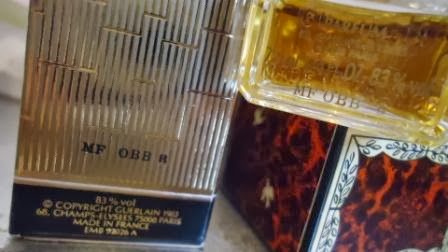
- M = 1980
From 1981 — at least 6 or 7 digits. If the first letter is:
- U = 1981
- Z = 1982
- J = 1983
The second letter indicates the month: H=January, E=February, B=March, X=April, T=May, K=June, L=July, N=August, F=September, R=October, A=November, C=December.
From 1984 until 1989
- Y = 1984
- W = 1985 (example: WB 6AA 1)
- P = 1986
- S = 1987 (example: SA 4BC 1)
- V = 1988
- D = 1989
From 1990 — the barcode appears on the box.
- M = 1990 (example: MH 3AA 2)
- U = 1991
- Z = 1992 (example: ZX 4BB 1)
From 1993 — the Green Dot appears on the box.
- J = 1993
- Y = 1994
- W = 1995
The second letter is the month, same scheme: H=January, E=February, B=March, X=April, T=May, K=June, L=July, N=August, F=September, R=October, A=November, C=December.
From 1995 to 2001 — 5 digits.
- P = 1996 (e.g. PE A D2)
- S = 1997 (e.g. SX A S1)
- V = 1998 (e.g. VR 0 VS)
- D = 1999 (e.g. DB 0 RS)
- M = 2000 (e.g. MH 1 RP)
- U = 2001 (e.g. UT 0K 1)
The second letter is the month: H=January, E=February, B=March, X=April, T=May, K=June, L=July, N=August, F=September, R=October, A=November, C=December.
The modern batch codes (since 2002)
(from 2002 to 2007): 4 digits starting with a number and a letter from the 1st half of alphabet (A-to-M)
- 2 = 2002 (e.g. 2J02, but there are very few bottles with the old 5-digits batch)
- 3 = 2003 (e.g. 3B01)
- 4 = 2004
At this stage, the LONG LIST of Ingredients is printed on the box.
- 5 = 2005 (e.g. 5C01)
- 6 = 2006 (e.g. 6D02)
- 7 = 2007
SINCE 2008 to 2017 : 4 digits starting with a number and a letter from the 2nd half of alphabet (N-to-Z)
- 8 = 2008 (e.g. 8R01)
- 9 = 2009 (e.g. 9W02)
- 0 = 2010
- 1 = 2011 (e.g. 1T01)
- 2 = 2012
- 3 = 2013 (e.g. 3N01)
- 4 = 2014
- 5 = 2015 (e.g. 5P02)
- 6 = 2016
- 7 = 2017 (e.g. 7R01)
Then in 2018, the cycle repeats: 4 digits starting with a number and a letter from the 1st half of alphabet (A-to-M), so:
- 8 = 2018 (e.g. 8F01)
- 9 = 2019 etc.
Now you can go directly to tutorial pics below.
(I would want to thank all people from Parfumo and Basenotes for helping me with all these numbers, plus "MonsieurGuerlain2", "GuerlainPerfumeBottles", and other people I don't know their name. I'll be happy to add their names on every picture and reference, on request)
TUTORIAL PICS
A note on stickers: those found on boxes and bottles can be a reliable dating tool for fragrances produced before 1976. See the dedicated section here.
1976 (batch codes starting with "P")


1977 (batch codes starting with "S")
1979 (batch codes starting with "D")


1980 (batch codes starting with "M")

MF 1056CE1 = 1980, September
1981 (batch codes starting with "U")

1982 (batch codes starting with "Z")


1983 (batch codes starting with "J")
New Black & Gold boxes appear. Old B&W ZigZag boxes fading out.

1984 (batch codes starting with "Y")
Old B&W ZigZag boxes finally discontinued.


1985 (batch codes starting with "W")


1986 (batch codes starting with "P")


1987 (batch codes starting with "S")


1988 (batch codes starting with "V")


1989 (batch codes starting with "D")


1989-1990: EAN barcode is shown on the boxes. Here is an example of the EAN Barcode:

1990 (batch codes starting with "M")


1991 (batch codes starting with "U")


1992 (batch codes starting with "Z")


batch ZF2BB1 = September, 1992

ZK 2CE2 = June, 1992
1993 (batch codes starting with "J")
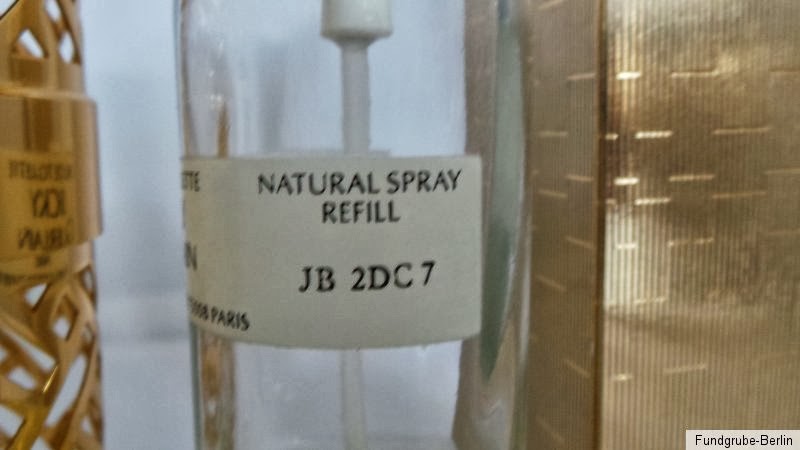
batch JB 2DC7 = March, 1993

batch JX 2GA5 = April, 1992

Heritage, batch JK 2118 = June, 1993
1994 (batch codes starting with "Y")

batch YC 4EF4 = December, 1994

batch YK 4AB1 = June, 1994

batch YE 4AA 1 = February, 1994

batch YC 4HA4 = December, 1994
1995 (6 digits batch codes starting with "W")
it's the last year with 6-digits batches

batch WB 5AC2 = March, 1995
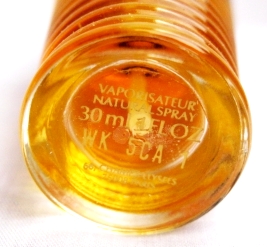
batch WK 5CA1 = June, 1995

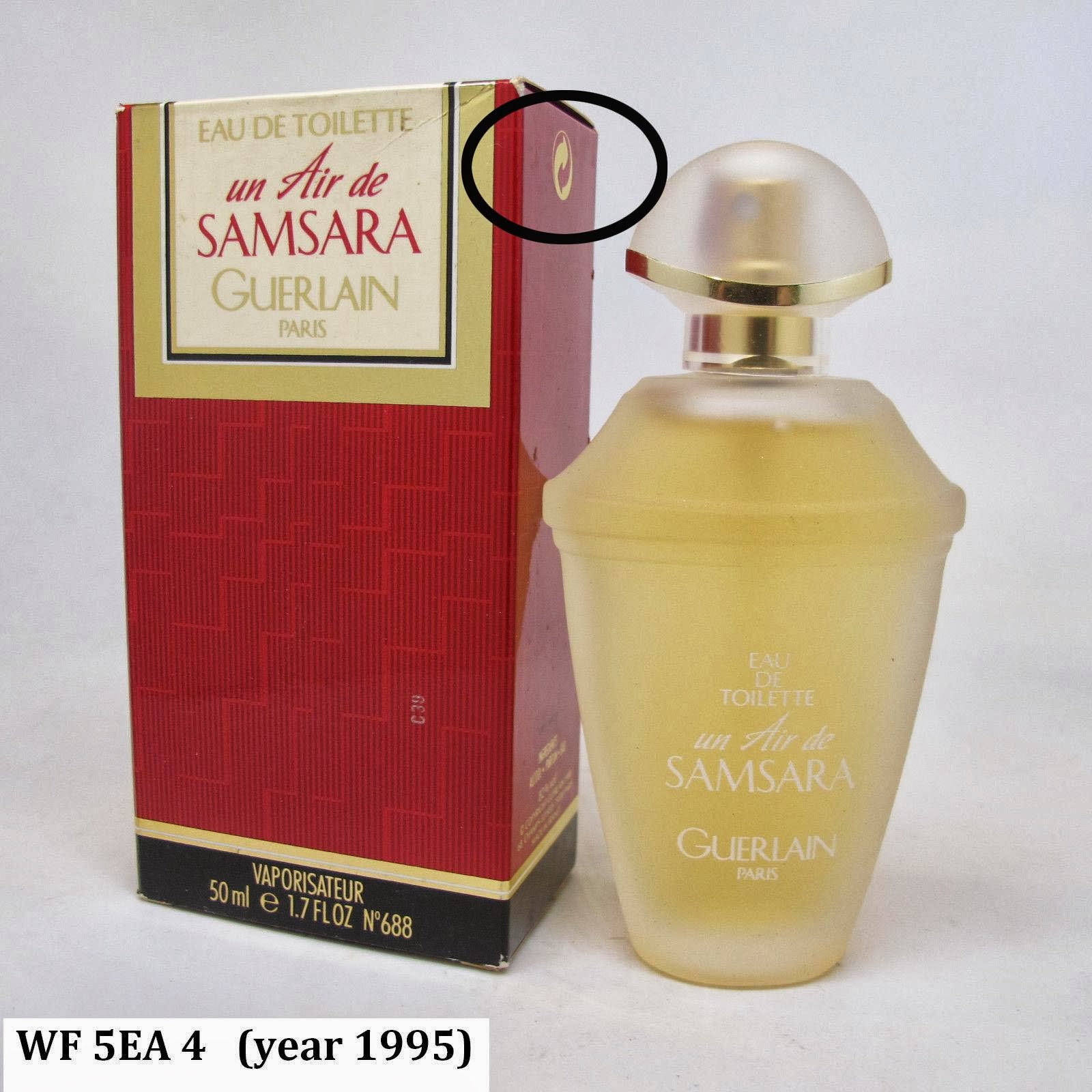
code starting with WF, year 1995
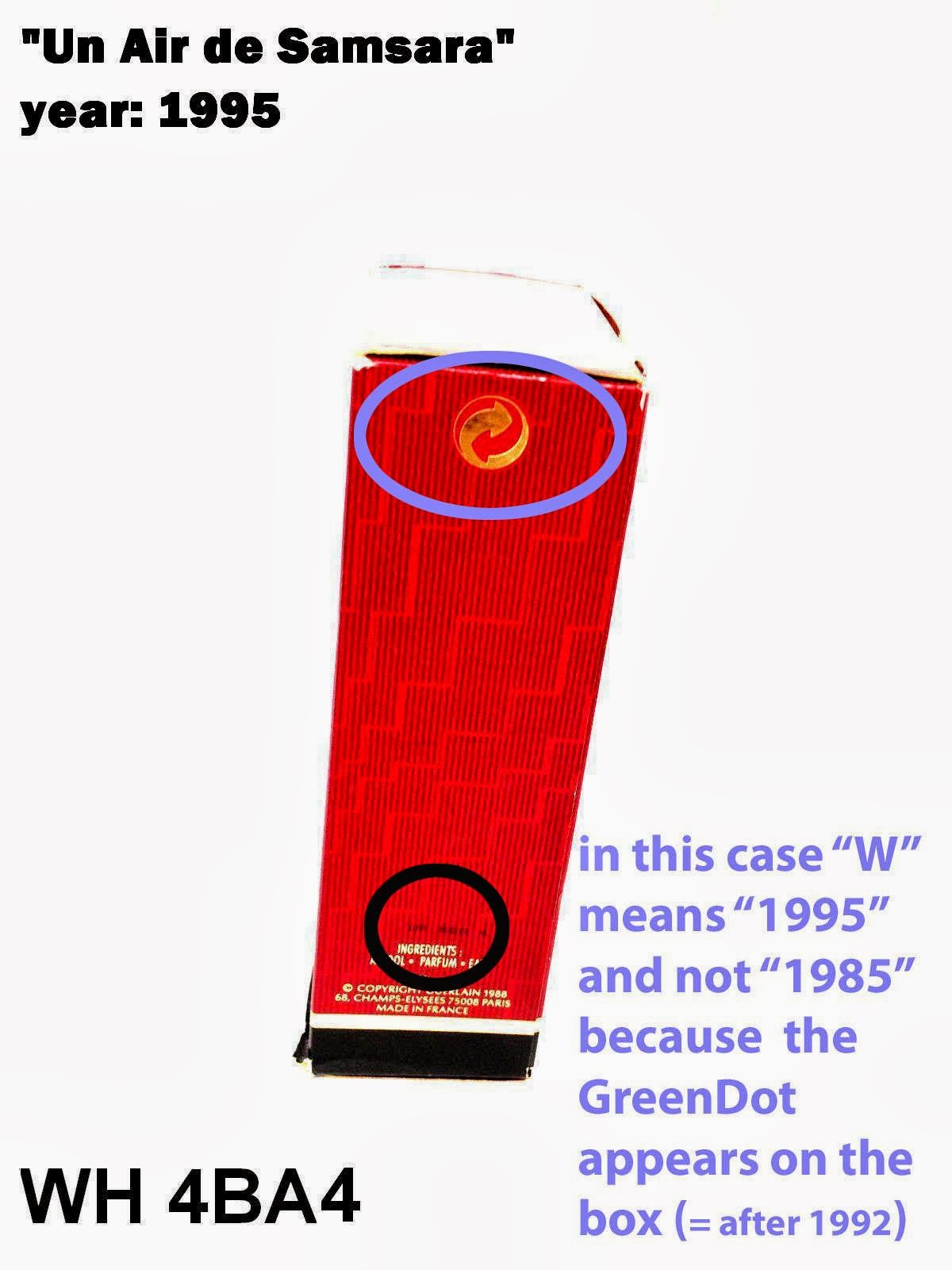
batch number starting with WH = year 1995
1996-2001: 5-digits batch codes
1996 (5 digits, starting with "P")
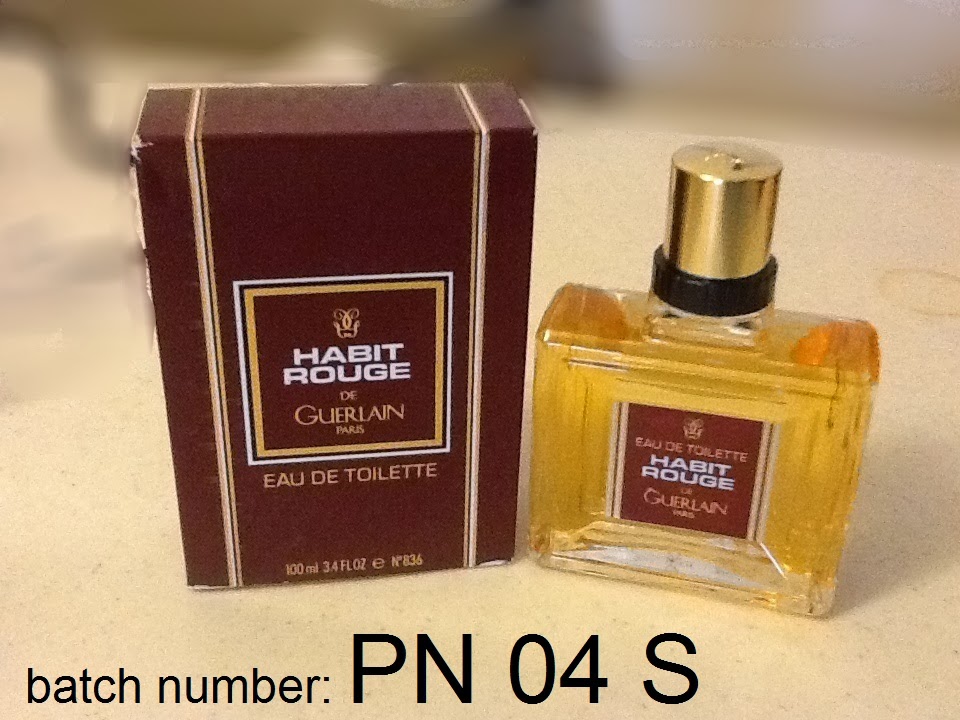

batch PH 1F2 = January, 1996

1997 (batch codes starting with "S")

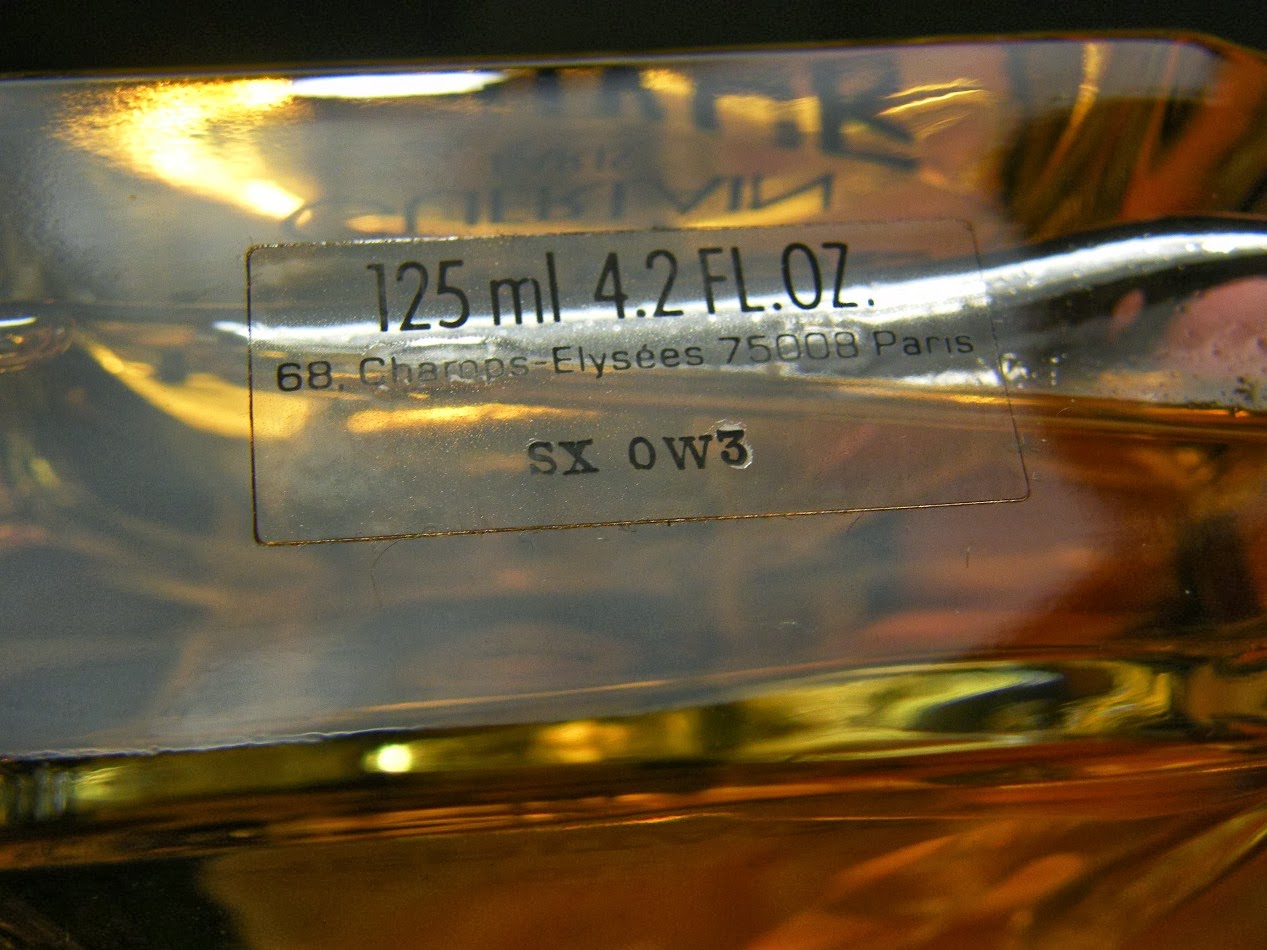
batch SX0W3 = April, 1997
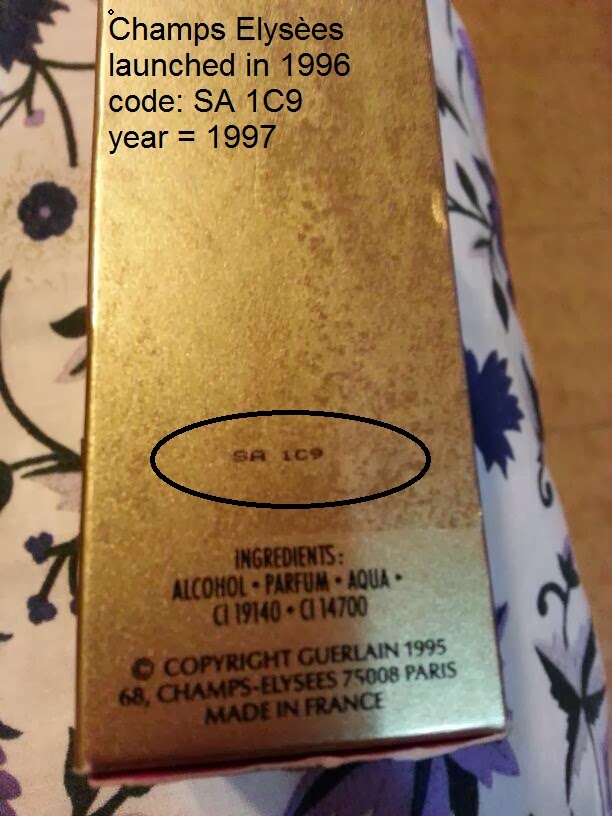
batch code SA 1C9 = November, 1997
1998 (5 digits, starting with "V")
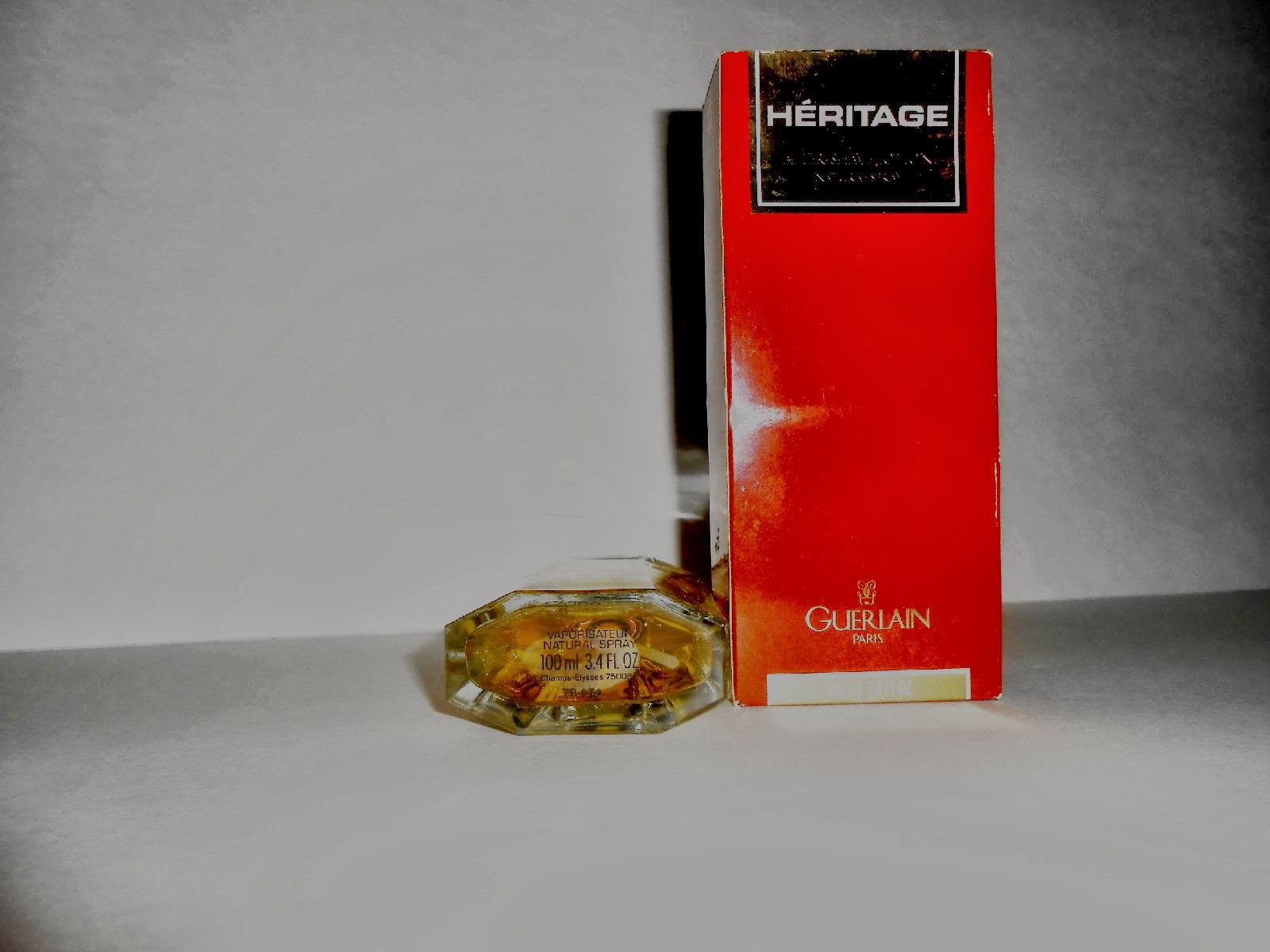
batch VRxxx = October, 1998
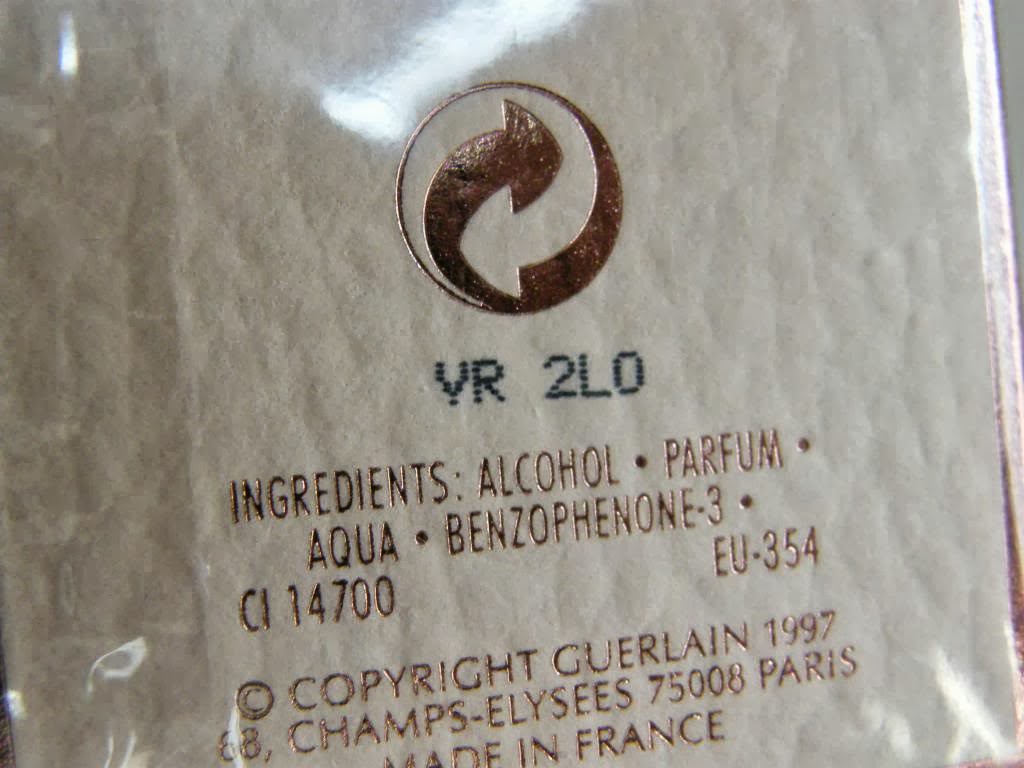
"VR 2LO" = October, 1998.

batch VR 1S1 = October, 1998
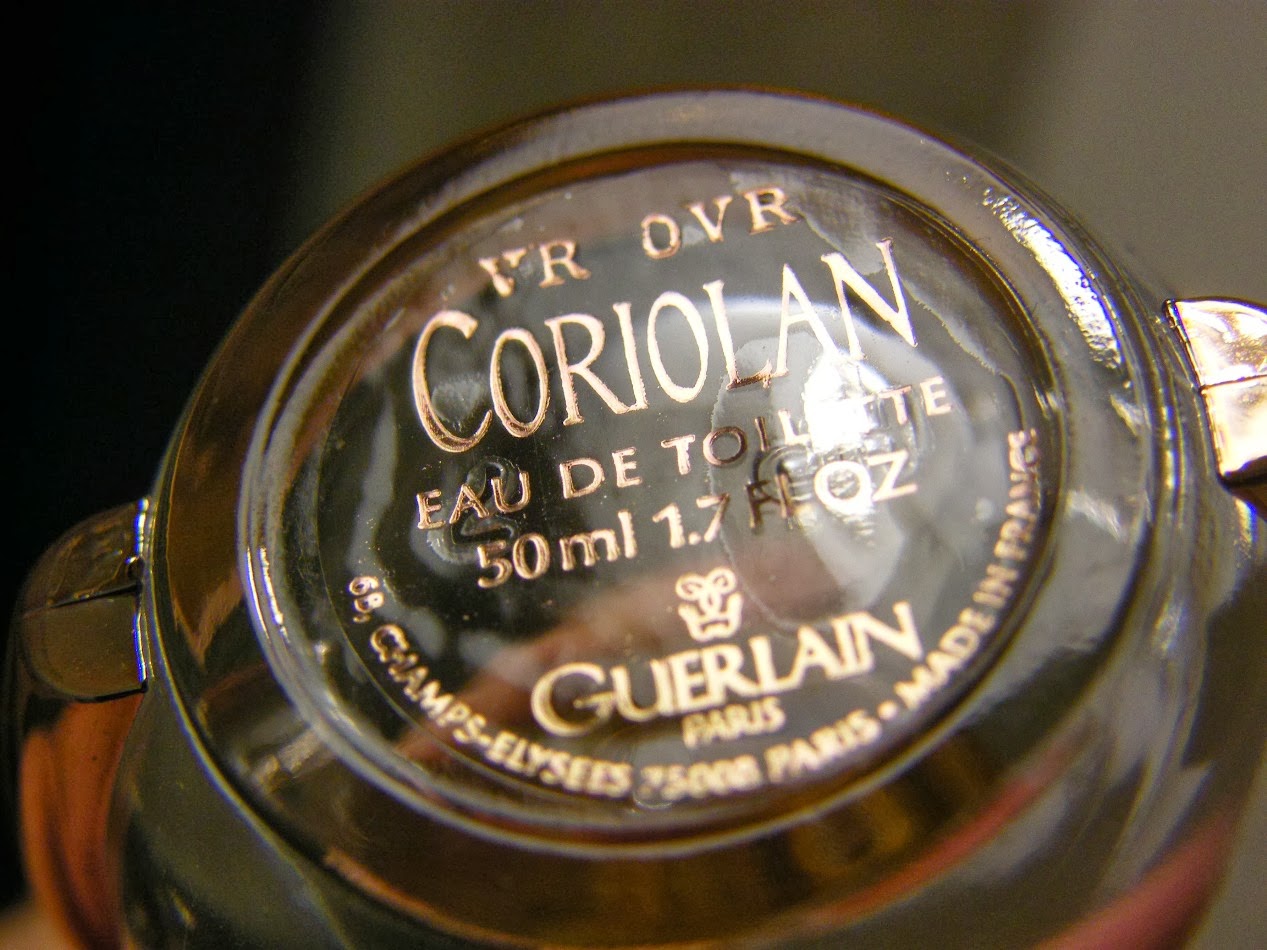
"VR 0 VR" = October, 1998
1999 (5 digits, starting with "D")

batch DX0VD = April, 1999

batch DR18E = October, 1999

batch DK 0BR = June, 1999
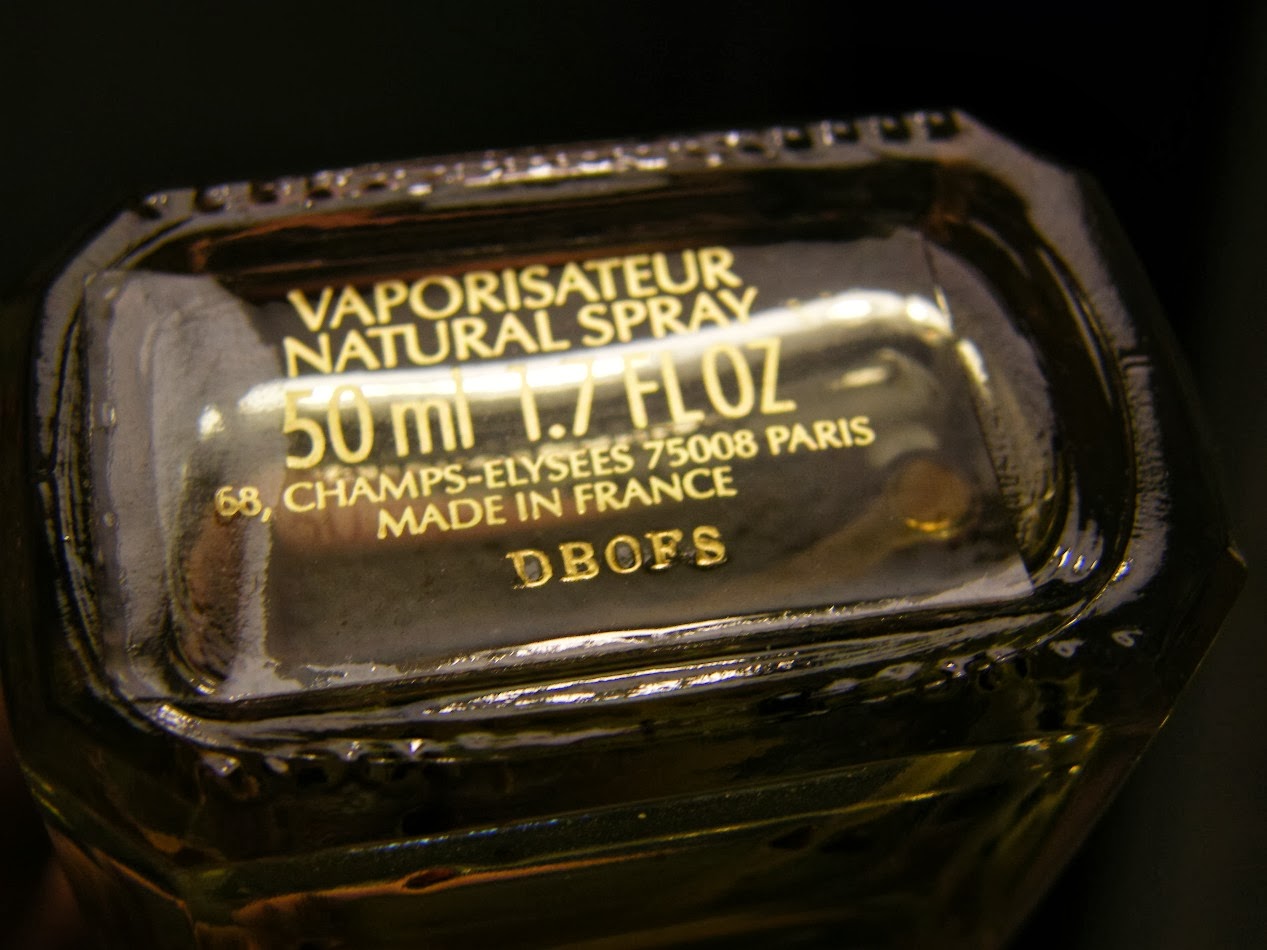
batch DB 0FS = March, 1999
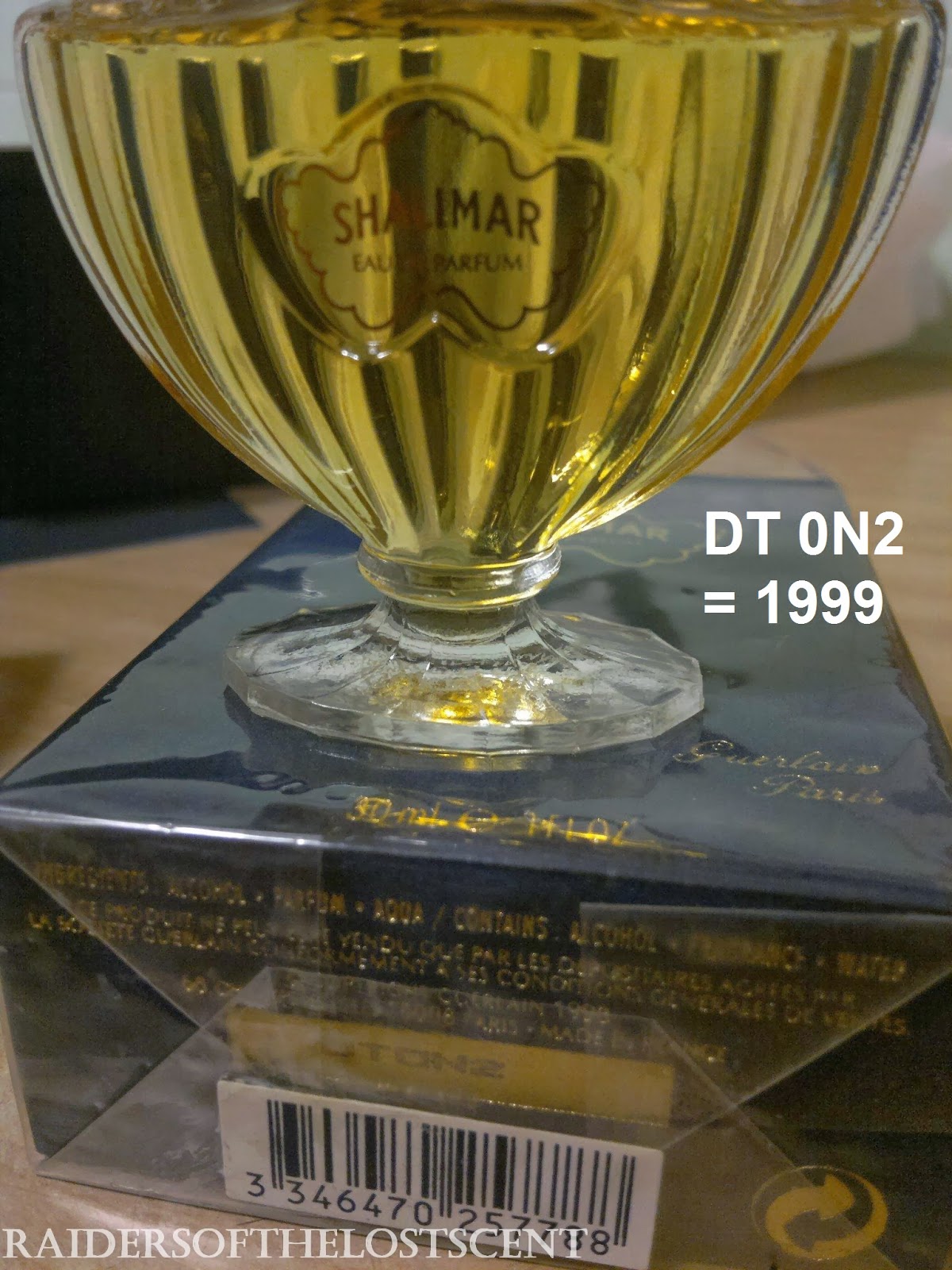
Batch DT 0N2 = May 1999

batch DK 0KP = June, 1999
2000 (5 digits, starting with "M")
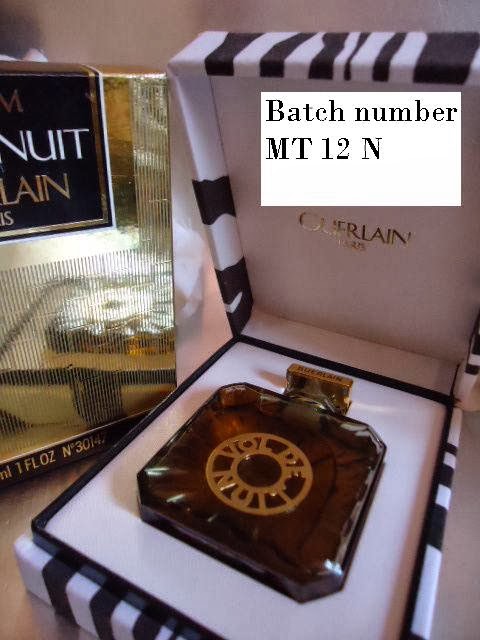
MT12N = year 2000

MF 0MB = September, 2000

batch MB11Y = March, 2000

batch MT113 = May, 2000


batch MR0K6 = October, 2000
2001 (5 digits, starting with "U")
It's the last year with 5-digits batches
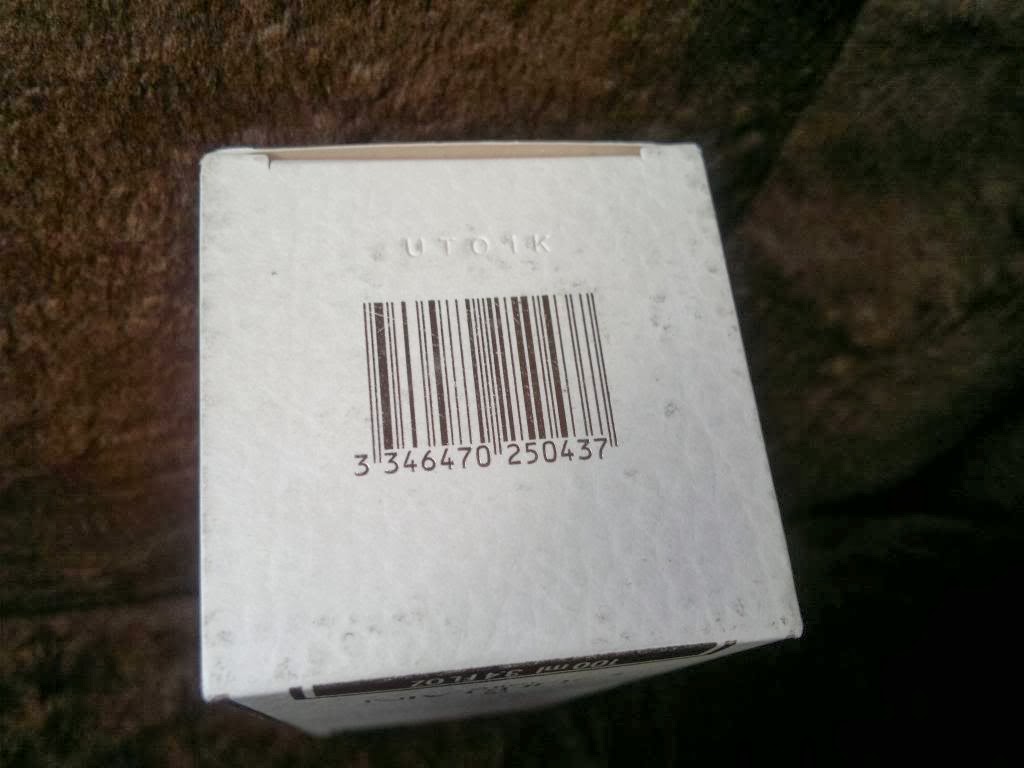
"UT 01K" = May, 2001

batch UE 1JC = February, 2001

batch UL 2G0 = July, 2001
SINCE 2002: 4-digits batch code
2002-2007: letters A-to-M
2008-2017: letters N-to-Z
2018-..... : letters A-to-M, again.

Habit Rouge year 2002 with the old 5-digits batch
ZE 1CN = February, 2002
2002-2007: 4 digits, letters A-to-M
A= January, B=February, C= March, D=April, etc.
2002

2004


batch 4K03 = year 2004
Since 2005: list of allergens/ingredients on the box
2005


batch 5C01 = March, 2005

batch 5E01 = year 2005
2006

Batch 6D01 = year 2006

batch 6Q01 = year 2006
2007

batch 7G01 = year 2007

batch 7M01 = year 2007
2008-2017 (letters N-to-Z)
2008

batch 8N01 = year 2008

batch 8X01 = year 2008
2009

batch 9X01 = year 2009

batch 9V01 = year 2009
2010

batch 0Z01 = 2010, December

batch 0S01 = year 2010
2011

batch 1T01 = year 2011

1Q01 = year 2011
2012

batch 2R01 = year 2012

batch 2P01 = year 2012
2013

batch 3X01 = year 2013
2014

batch 4N01 = year 2014

batch 4X02 = year 2014
2015

batch 5N01 = January, 2015
2018: (letters from A-to-M, again)

If you want to estimate the production year of your Guerlain perfume bottle using the stickers on the bottles and packaging, then read the "Guerlain Sticker Guide".
If you're interested in Guerlain reformulations and how the fragrances have changed over time, check out the "Guerlain Reformulation Guide".
About the Authors: We are a collective of fragrance specialists and historians based in Italy, France and Switzerland, dedicated to the study and preservation of olfactory heritage. Founded in 2009, our project is rooted in a family lineage in the art of perfumery dating back to 1919. Bringing over a century of combined expertise to every review, we provide insights into the world of vintage scents. Every article is a result of research and experience with original specimens. Images posted for purely informative and historical purposes. All rights belong to their legitimate owners. Please note: Raiders of the Lost Scent is an independent editorial platform. We are not involved in the commercial trade of perfumes and do not sell fragrances.
Great Information to buy online
ReplyDeletePerfumes .. I am waiting for your next post
hello,
ReplyDeleteI have a question, if my box has no batch numbers nor does my bottle, which si a recharge vaporisateur of Mitsouko, should I assume that it is a fake?
if the perfume smells like Mitsouko, with a longevity of about 4-5 hours at least.....well, it's authentic.
DeleteHowever, sometimes labels on bottle could have been removed (phenomenon of "grey market")
It's strange not to see any code on the box, too.
Thank you Andre.
ReplyDeletei got a box today, at a closth cleaning, boxed and wel, there is the 5m01, its mitsouko edt bath numer also on the bottel,
ReplyDeleteunder the box its also written in arabic? is that fake? even the smell is not for 4 hours on my arm.
Hi sapphire,
Deleteit's year 2005, it should be a "yellow and gold" box.
Yes, there are arabic letters on the bottom of the box. apparently it's not a fake.
Thank you adre for the answer :-)
ReplyDeleteHi ,I've got a 7,5 ml 6 digit Shalimar ,without the box.I have a big questionmark regarding the way it was sealed: instead of the usual cord it had a small transparent plastic around the neck.Is this seal in fact a fake one,did they ever put a plastic collar instead of a cord ?
ReplyDeletePlease help me solve the mystery.
Thank you !!!!!
Yes! Many perfumes had a small "plastic collar" around the bottle. Enjoy your Shalimar!
DeleteThank you ! I would have enjoyed as is in a past life ,when beeing an arab , but in this one I will need to combine it to transform it in a feminine scent :-) .
ReplyDeleteIt's rather suitable for an english governess type of person.
A big THANK YOU to your work and efforts !
Hi Andre , I am trying to locate in time another Guerlain:ZB1CB4 in a golden zig-zag box ,pre barcode and with no double G logo.
ReplyDeletePlease help me out this time again.
Merci Beaucoup !!!!
Hi, it *could* be March 1992. Producers used often old boxes until end of stocks, applying the barcode on the cellophane. You could have hints by the shape of the bottle, too.
DeleteThank you.
ReplyDeleteIt's the golden cilindrical canister,refillable of course.
93ml
This has been a really helpful blog post. I am new to collecting and knowing what to look for with the codes allowed me to avoid purchases where the item was described as vintage, but the batch was within the last decade. Thank you!
ReplyDeletehi there,
ReplyDeletei did read about Samsara extrait de parfum in bottels of 15-35ml
i have a bottle of 30ml extrait de parfum, code yn 4cd 2, even i did look around the web, i can not believe it is not real,,, even i don't know what year it may have been. any idea if it is real or not?
thanks in advance
Hi Sapphire, batch 4Cd2 = year 2004.
DeleteExtrait bottles of with an amount of "30 ml" are perfectly legit.
cheers, Laura
Hello,
DeleteAfter learning that Shalimar Parfum Initial is being discontinued last month, I purchased 4 bottles from Amazon.
The cellophane on the outer boxes didn't seem fully adhered.
The box and the appearance of the bottles seemed normal. The code on the bottom is 3Y01.
I opened two of the four bottles. One cap seemed oddly loose.
The longevity seemed to be 30 minutes. Very short-lived!
It didn't have the same beautiful scent I experienced with previous bottles.
I got itchy and red where I sprayed it on my neck.
So, my question is: have you heard of people using genuine/authentic boxes and perfume bottles, and, filling them with fake/counterfeit perfumes?
Thank you in advance for your consideration and for sharing your thoughts
I guess that Guerlain startet using letters A-M again from 2018 on since I do have a L'Heure Bleue EdT with batch code 8A01 and formula 11153 (2017+) and a Shalimar EdC with batch code 8J01.
ReplyDelete
ReplyDeleteMy cousin recommended this blog and she was totally right keep up the fantastic work!
Bulk fragrance oils.
Hello, I have purchased a bottle of Shalimar EDT in the black and gold "zigzag" or "bamboo" box. The date code on the bottom is 3A01. This would put the date of manufacture at 2003, correct? You said some blue and black boxes were in use up until 2007?
ReplyDeleteExactly! Your black and gold Shalimar box is "year 2003" Greetings, Enzo
Deletei am looking at a habit rouge 100mL spray bottle with gold sprayer/cap. the tall, "listerine" style of bottle. the box has a bar code. i think the box also has a green dot, but i am not sure. batch code is ZX19D.
ReplyDeletethis conflicts with your information because it is a 5-character batch code, but it starts with Z. according to your information, 5char codes start in 1995, but a code starting with Z should be 1992 or 1982.
can you please advise me on how to date this bottle? thanks
Hi Gary! your Habit Rouge bottle is OK and batchcode ZX19D means "2002". Actually, Guerlain started the 4-digit code in the middle of 2002, so you can find bottles with the old 5-digits code during 1992. Letter X means "April", so it's "2002, April". Have a nice day! Laura
DeleteCan the vintage of Samsara eau de Perfume be revealed from a 13 digit bar code on the bottom of the box?
ReplyDeleteHi, probably not; numbers in barcodes are usually used for inventary purposes and to identify quantities (30 ml, 50ml, 75 ml etc.) and type of bottles, but not the year of production. Greetings , Laura
DeleteDoes this bottle style have a name? This is a 50ml bottle of Shalimar that I am assuming is from the mid 1980s?
ReplyDeletehttps://i.imgur.com/iEeFICt.jpeg
Hi Nosey74 I don't know any particular name for that bottle, but I noticed it only during the 80's, the capacity was 30 ml, and the scent was "Derby"; and 50ml for "Shalimar", sold in USA. Greetings, Laura.
DeleteDelete
I'm writing to ask if previous vintage editions of Guerlain Paris - L'Heure Bleue bottles had the Guerlain logo on the sprayer (the gold part) at the top, or were there also editions without it? I recently purchased a 50ml bottle of Guerlain Paris - L'Heure Bleue, batch code 6K01 (with a long list of ingredients and a 911M stamp at the end of the list) for my vintage collection. The label with the perfume name on the bottle is more white than yellow like the older versions. I wonder if it's the original :-)
ReplyDeletehi Magdalena, this is a good question! I checked my l'Heure Bleue bottles - all of them absolutely authentic - I can say that half the sprays have the Guerlain logo, and the other half do not.
DeleteSo it's perfectly normal to have a spray without the logo.
and yes, there are white labels instead of yellow ones. That's fine! Laura
Thank You Laura for the quick answear :-) I'm glad I found Your blog with all those infos about vintage perfumes :-)
DeleteHello, I inherited a large collection of vintage perfumes & your blog has been invaluable in helping me understand what I've got, thank you. I have a number of Guerlain & have dated them, however I have a question regarding the number on the front of some of the boxes (at the end of the volume info) eg Vetiver 200ml After Shave 1989 has 'No 905', Imperiale EDC 125ml 1992 has 'No 711 BIS', Vol De Nuit 30ml Parfum 1996 has 'No 30147'. These aren't the batch code & they don't look like the formula codes you show near the ingredients list. Are these a different way of showing the formula codes or are they something else entirely please? And are some more rare than others? Thank you so much x
ReplyDeleteHi Sandra, that's a good question! The numbers on the front of the boxes are the "reference numbers" and indicate "type of perfume and the capacity of the bottle". They have nothing to do with formula and batch codes; and are used only for the manufacturer's convenience.
DeleteThanks for replying so quickly. Here I was thinking (hoping) the number meant something special, especially as the perfume type & ml are on the box in great big writing! Your expertise being shared so freely is much appreciated, enjoy the coffee x
ReplyDeleteThis comment has been removed by the author.
ReplyDeleteHello! I have a bottle of AA Tiare Mimosa. It was created on 2009 and then was discontinued. The batch code on the bottom is MB10F. I have no idea what year and month it is. Would be great to hear your thoughts about it!
ReplyDeleteHi, 5-digits batchcodes were used between middle of 1995 and beginning of 2002. "MB10F" means exactly "Year 2000, March". So, there must be something wrong somewhere...... Hope this helps! Laura
ReplyDeleteKnow anything about dates/special market relases for Shalimar in a blue crystal bottle with a clear stopper?
ReplyDeleteI’ve done some googling and anything that comes up for sale is bottle in Asia…
Hello, sorry for the late reply. I did a very thorough search and wanted to be absolutely certain before responding. I received a response from a Swiss collector, and Yes, I have seen a bottle of Shalimar made of dark blue glass, with a transparent cap, and a sort of blue velvet box featuring a gold “Shalimar” emblem. It’s truly unusual. The concentration is eau de parfum, volume 30 ml / 1 oz, and the batch code is five digits starting with D, which indicates 1999. Hope this helps.
DeleteHi, I have a question about Guerlain packaging vs. reformulation.
ReplyDeleteI have an Après l’Ondée Parfum with a five-digit batch code starting with “U” (around 2001), in a Black & Gold box with a 1983 copyright. I’ve also seen a 2002 L’Heure Bleue in a very similar Black & Gold box, but with a 1997 copyright.
I’ve read that changes in packaging or bottle design don’t necessarily indicate a reformulation. So I’m wondering: when a fragrance is actually reformulated, does Guerlain usually update the packaging or copyright year, or can the formula change while everything on the outside remains exactly the same?
Thanks for any insight!
Good morning! Just a heads-up: the Guerlain copyright on the box only refers to the year the packaging and its design were registered. It has absolutely nothing to do with the perfume's formula. If you want to track when a fragrance was reformulated, you can only do so for bottles produced from 2003 onwards, which is when listing allergens became mandatory. You’ll need to look for the 'formula number' located at the very end of the long list of ingredients/allergens. Every time that number changes, it means the perfume has been reformulated. You can find a (slightly outdated) list of Guerlain reformulations here: https://www.raidersofthelostscent.blog/2018/01/a-letter-from-ex-guerlain-employee.html" regards, RotLS
DeleteHello and thank you for your hard work in getting this detailed information out. I recently acquired a 30ml bee bottle of Guerlain Muguet. The code is 5G01 on the label, unfortunately no box to compare it to. I have been getting mixed information online and I’m very worried I bought a counterfeit. The bottle and label looks and feels legit. I have never smelled/sampled Muguet so I can’t compare any memory to it. I did read Muguet is a very light and short lived fragrance. I question the code since it indicates July 2025 and I found out Muguet comes out only in the month of May. Do you have any opinions on this? Thank you.- Michele
ReplyDeleteHi Michele! Let’s take this step by step. A batch code like 5G01 could technically mean either 2005 or 2025. However, since Guerlain didn’t produce the Muguet bottles back in 2005, it must be from 2025. We know that these bottles were released as a limited edition starting in April 2025, in both 125ml and 30ml formats. Here is an image: see if it matches your 30ml bottle! https://pariscom2030.com/en/products/Guerlain-Muguet-Mill%C3%A9sime-2025-Limited-Edition-125ml-30ml?srsltid=AfmBOoqol3LY2dooRMI-dpg1Xvjzj2OUUJMxp8-uA33P5IXh2F3aY2io
Delete